In the realm of healthcare, technological advancements have always played a pivotal role in driving innovation and improving patient outcomes. Among the latest waves of transformative technologies, generative artificial intelligence (AI) stands out as a potent tool with vast potential. As we peer into the future, the trajectory of generative AI platforms in healthcare appears increasingly promising, offering unprecedented opportunities to revolutionize diagnosis, treatment, research, and patient care. In this comprehensive exploration, we delve into the evolving landscape of generative AI platform for healthcare, its emerging applications, challenges, and the transformative impact it promises to deliver.
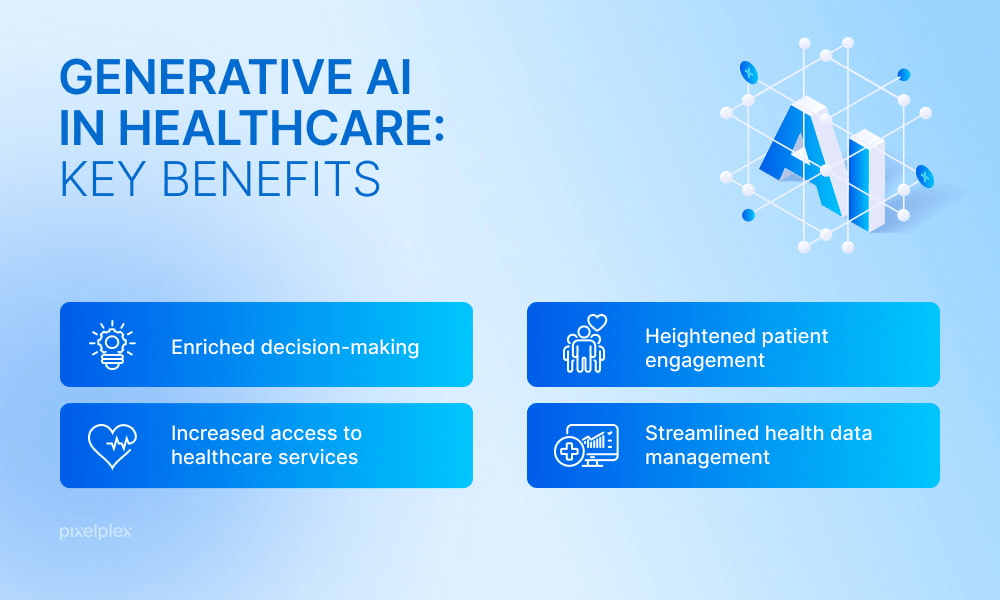
Unraveling the Potential of Generative AI in Healthcare
Generative AI represents a subset of artificial intelligence algorithms designed to generate new data or content based on patterns and relationships learned from existing datasets. Unlike traditional AI models that focus on classification or prediction tasks, generative AI platforms have the remarkable ability to create novel outputs, including images, text, sounds, and entire scenarios. This capacity stems from their underlying architecture, often built upon deep neural networks, which excel at capturing complex data distributions and generating realistic samples.
In the context of healthcare, generative AI platform for healthcare holds immense promise across a spectrum of applications, reshaping the landscape of patient care, medical research, and healthcare delivery. From enhancing medical imaging to accelerating drug discovery, optimizing treatment planning to enabling personalized medicine, generative AI platforms are poised to usher in a new era of innovation and efficiency in healthcare.
Anticipated Applications of Generative AI in Healthcare
1. Advanced Medical Imaging and Diagnosis
Generative AI platform for healthcare is poised to revolutionize medical imaging and diagnosis by enhancing the quality, accuracy, and speed of image interpretation. Leveraging techniques such as image synthesis, super-resolution, and anomaly detection, these platforms empower healthcare providers to detect abnormalities, identify diseases, and predict patient outcomes with unprecedented precision. By harnessing the power of generative AI, radiologists and clinicians can unlock new insights from medical images, leading to earlier detection, more targeted interventions, and improved patient outcomes.
2. Accelerated Drug Discovery and Development
The process of drug discovery is notoriously complex, costly, and time-consuming. Generative AI platform for healthcare offers a transformative solution by expediting the identification and design of novel therapeutic compounds. Through generative modeling, researchers can generate virtual chemical structures, predict their properties, and screen for potential drug candidates with enhanced efficacy and safety profiles. By leveraging the predictive power of generative AI, pharmaceutical companies can streamline the drug development pipeline, bringing life-saving medications to market more rapidly and cost-effectively.
3. Personalized Medicine and Treatment Optimization
Personalized medicine, which tailors medical treatment to individual characteristics, holds immense promise for improving patient outcomes and reducing healthcare costs. Generative AI platform for healthcare plays a pivotal role in this paradigm shift by analyzing patient data, including genomic information, clinical records, and demographic factors, to develop personalized treatment plans and predictive models. By harnessing the power of generative AI, healthcare providers can deliver more targeted interventions, optimize therapeutic outcomes, and enhance the overall quality of patient care.
4. Natural Language Processing (NLP) in Healthcare
Generative AI is poised to revolutionize healthcare through natural language processing (NLP) techniques, enabling advanced analysis of unstructured text data from electronic health records (EHRs), medical literature, and patient-generated content. By extracting valuable insights, automating clinical documentation, and supporting decision-making processes, NLP-powered generative AI platforms facilitate communication between healthcare professionals, streamline administrative tasks, and enhance the efficiency of healthcare delivery.
Addressing Challenges and Barriers to Adoption
Despite the immense potential of generative AI in healthcare, several challenges and barriers to adoption must be addressed to realize its full impact. Key considerations include:
1. Data Privacy and Security
Healthcare data is highly sensitive and subject to stringent privacy regulations, necessitating robust data protection measures to safeguard patient confidentiality and comply with regulatory requirements. Generative AI platform for healthcare must prioritize data privacy and security, implementing encryption, access controls, and anonymization techniques to mitigate the risk of unauthorized access and data breaches.
2. Ethical and Regulatory Compliance
The use of generative AI in healthcare raises ethical concerns regarding patient consent, algorithmic bias, and the responsible use of AI-driven solutions. Healthcare organizations and technology developers must navigate ethical dilemmas and ensure compliance with regulatory standards to uphold patient safety and trust.
3. Interoperability and Integration
Achieving seamless interoperability and integration among disparate healthcare systems is essential for the effective deployment of generative AI platforms. Healthcare organizations must leverage interoperability standards and interoperable technologies to facilitate data exchange and interoperability across different systems, enabling more comprehensive and coordinated care delivery.
4. Explainability and Interpretability
Ensuring the explainability and interpretability of generative AI platforms is crucial for gaining trust and acceptance from healthcare professionals, patients, and regulatory authorities. Techniques such as model visualization, feature attribution, and algorithmic transparency can help elucidate the underlying mechanisms of generative AI, enabling stakeholders to understand how decisions are made and assess their reliability and validity.
Envisioning the Future of Generative AI in Healthcare
Looking ahead, the future of generative AI in healthcare is brimming with potential, offering transformative opportunities to enhance patient care, drive medical innovation, and improve healthcare outcomes. As technology continues to evolve and mature, generative AI platforms will play an increasingly central role in shaping the future of healthcare delivery, research, and precision medicine.
By fostering collaboration, promoting transparency, and addressing the challenges of data privacy, ethical compliance, and interoperability, we can unlock the full potential of generative AI to revolutionize healthcare on a global scale. From personalized treatment strategies to predictive analytics, disease modeling to virtual patient simulations, the applications of generative AI in healthcare are boundless, paving the way for a future where healthcare is more precise, proactive, and personalized than ever before.
In conclusion, the future of generative AI platforms in healthcare holds tremendous promise, offering transformative solutions to address the complex challenges facing the healthcare industry. By harnessing the power of generative AI and overcoming the associated hurdles, we can realize a future where healthcare is more efficient, effective, and equitable, ultimately leading to better health outcomes and improved quality of life for patients worldwide.
 Digital Insight Marketing
Leave a comment